


Description
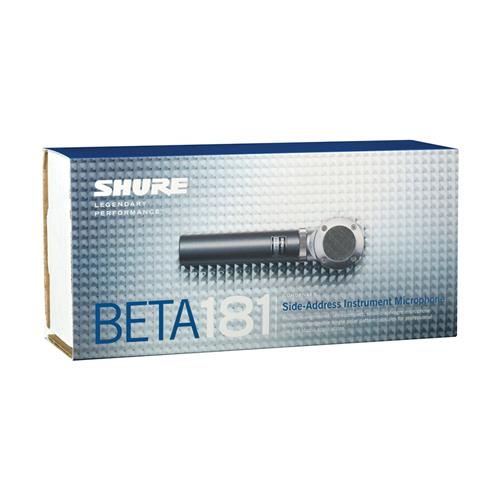
Side-Address Condenser Microphone with interchangeable capsules
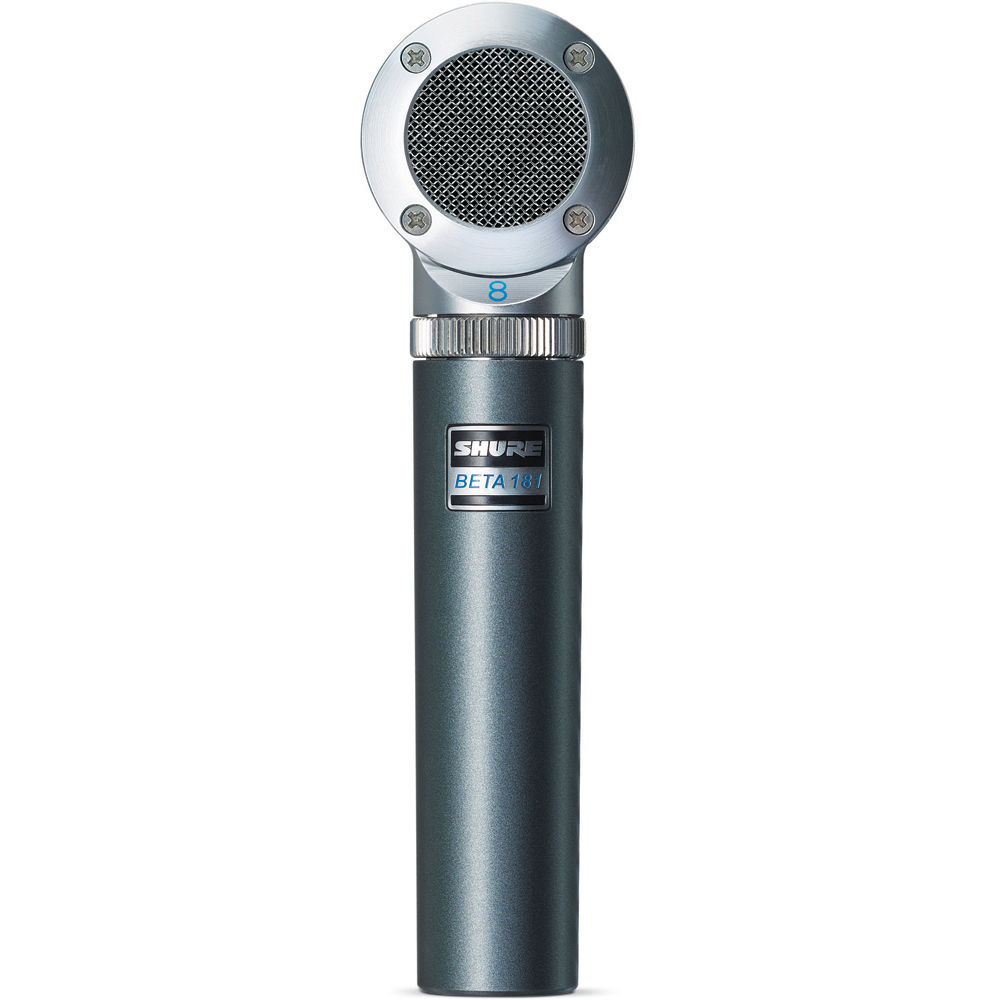
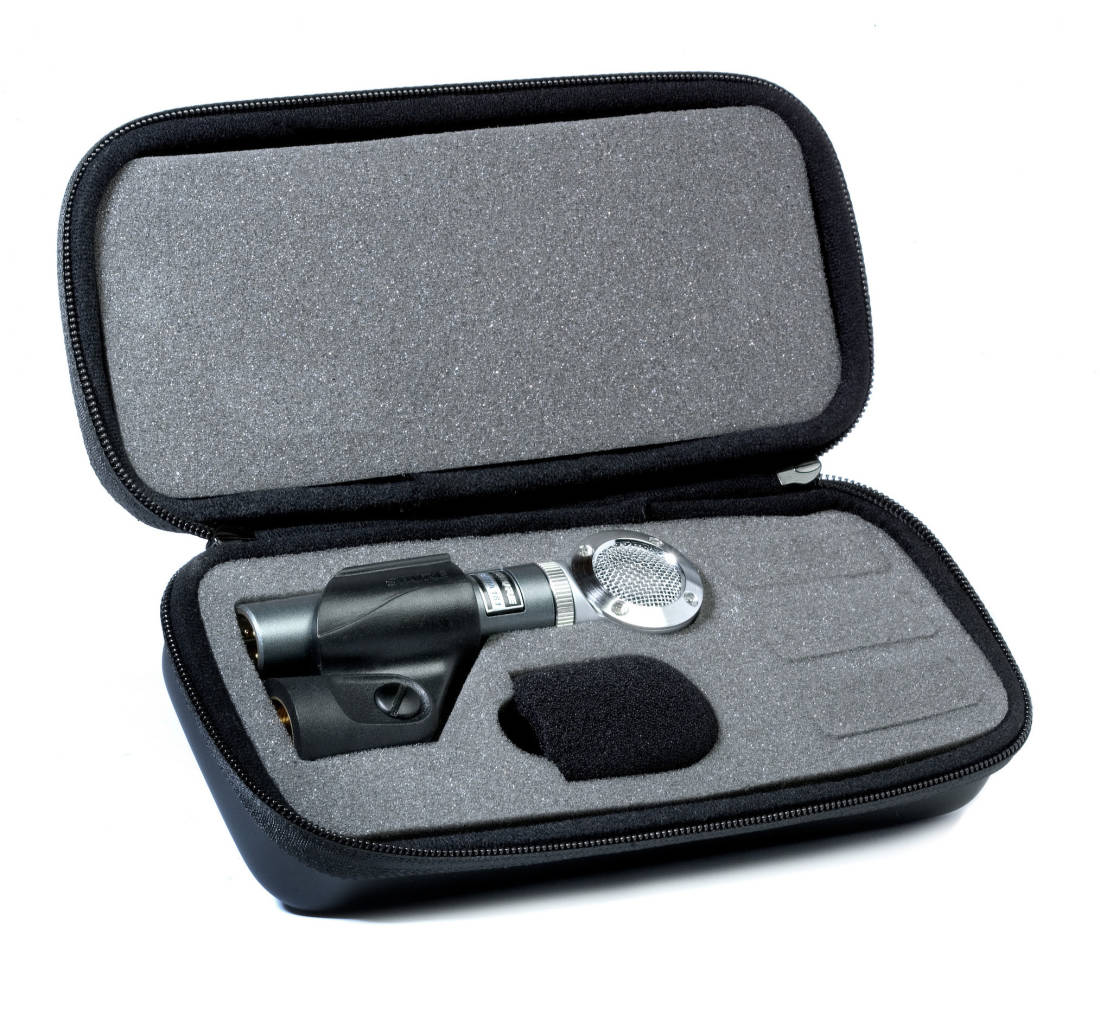
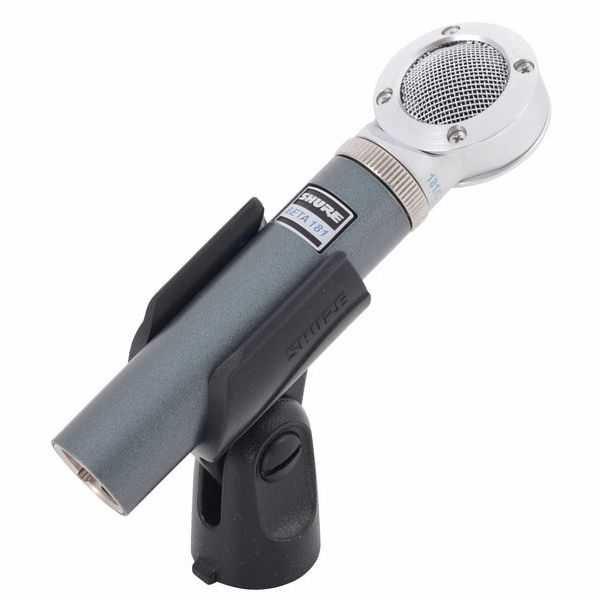
Side-address condenser microphone includes XLR preamplifier, microphone clip, windscreen, zippered case, and choice of condenser capsule. Capsule options include cardioid, supercardioid, bi-directional, and omni-directional polarities.
PRODUCT DETAILS
Beta 181 Applications
This Beta 181 is a multipurpose instrument microphone and can be used on a wide variety of applications including guitars, bass and drums (overheads and snares). A total of four different capsules (Cardioid, Supercardioid, Bi-directional, Omni-directional) are available, allowing you to interchange them according to application.
Interchangable Capsule Options
The RPM181/C is a cardioid condenser capsule for the Beta 181. The RPM181/S is a super cardioid condenser capsule for the Beta 181. The RPM181/BI is a bi-directional condenser capsule for the Beta 181. The RPM181/O is a omni directional condenser capsule for the Beta 181.
Applications for the different capsules
The cardioid capsule is best suited to overheads, piano and acoustic instruments. You can also use the cardioid capsule for M/S stereo micing (in conjunction with another microphone with a bi-directional capsule). The supercardioid capsule is best suited to snare, toms, acoustic instruments and other forms of close distance micing. The omni-directional capsule could be used for choirs, orchestras and ambient recording applications. Lastly, the Bi-directional capsule can be used for mono overheads, or for the recording of two instruments simultaneously on one channel.
In the Box
The Beta 181 can be purchased with any one of the four mic capsules available. You'll then need to buy any additional capsules you want seperately.
- Interchangeable polar pattern capsules attach to a compact preamplifier with integrated XLR connections
- Precision-engineered, compact side-address design features innovative locking ring to provide secure connection between capsule and preamplifier
- Frequency response tailored for wide dynamic range applications for use in high SPL environments
General Description
The Shure Beta 181 is an ultra-compact, side-address, condenser microphone, designed for discreet placement in live and studio environments. Featuring interchangeable cardioid, supercardioid, omnidirectional and bidirectional capsules for superior versatility, the small diaphragm of the Beta 181 provides superior audio with consistent, “textbook” polar responses in a form factor small enough to get close to the source in the tightest conditions.
Features
- Premier live performance microphone with Shure quality, ruggedness, and reliability
- Compact preamp attaches to four interchangeable capsules
- Wide dynamic range for use in high SPL environments
- Side-address form allows for discreet positioning in tight performance and recording settings
- Innovative locking ring provides a secure connection between capsule and preamp
- Hardened steel mesh grille resists denting, wear, and abuse
- Compact design, under 12 cm (5 in.), reduces stage clutter
- Furnished with stand adapter and carrying case
Variations
- Beta 181/C Cardioid Microphone
- Beta 181/S Supercardioid Microphone
- Beta 181/O Omnidirectional Microphone
- Beta 181/BI Bidirectional Microphone
Performance Characteristics
- Exceptional low-frequency reproduction
- Extremely high SPL handling
- High output level
- No crossover distortion
- Transformer output
Applications
Positioning the Microphone
The front of the microphone is marked by the Shure logo. Position this side toward the sound source.

General Rules for Use
- Do not cover any part of the microphone grille with your hand, as this will adversely affect microphone performance.
- Aim the microphone toward the desired sound source (such as the talker, singer, or instrument) and away from unwanted sources.
- Place the microphone as close as practical to the desired sound source.
- Work close to the microphone for extra bass response.
- Use only one microphone to pick up a single sound source.
- For better gain before feedback, use fewer microphones.
- Keep the distance between microphones at least three times the distance from each microphone to its source (“three to one rule”).
- Place microphones as far as possible from reflective surfaces.
- Add a windscreen when using the microphone outdoors.
- Avoid excessive handling to minimize pickup of mechanical noise and vibration.
Applications and Placement
The following table lists the most common applications and placement techniques. Keep in mind that microphone technique is largely a matter of personal taste; there is no one "correct" microphone position.
| Cardioid | Supercardioid | Omnidirectional | Bidirectional |
|---|---|---|---|
|
|
|
|
As with all bidirectional microphones, sounds picked up from the back will be out of polarity with the source. Those from the front are in polarity with the source.
Avoiding Pickup of Unwanted Sound Sources
Directional microphones are most sensitive to sounds arriving on axis and reject at angles depending upon the polar pattern. The following chart shows the rejection angles of each microphone. In live performance or recording settings, align monitors, P.A. loudspeakers, and unwanted sound sources at these angles.
To minimize feedback and ensure optimum rejection of unwanted sound, always test microphone placement before a performance.
| Cardioid | Supercardioid | Bidirectional |
|---|---|---|
|
|
|
|
| Off-axis null points at 180 degrees | Off-axis null points at 120 degrees | Off-axis null points at 90 degrees |


Changing Capsules
Follow these steps to change Beta 181 capsules:
- Turn off phantom power and disconnect from equipment.
- Unscrew the capsule's knurled ring to detach the preamp.
- Slide the alignment key on the bottom of the capsule into the groove on the preamp to ensure that the Shure logo displays the front of the microphone.
- Tighten the knurled ring to securely reconnect the microphone.


NOTE: Before each use, make surethe capsule is tightly secured on the micropgone, as vibration and accidental hits with drumsticks may loosen it, resulting in signal loss.
Load Impedance
Maximum SPL capability, output clipping level, and dynamic range vary with the input load impedance of the preamplifier to which you connect the microphone. Shure recommends a minimum input load impedance of 1000 Ω. Most modern microphone preamplifiers meet this requirement. Higher impedance results in better performance for these specifications.
Power Requirements
This microphone requires phantom power and performs best with a 48 Vdc supply (IEC-61938). However, it will operate with slightly decreased headroom and sensitivity with supplies as low as 11 Vdc.
Most modern mixers provide phantom power. You must use a balanced microphone cable: XLR-to-XLR or XLR-to-TRS.
Specifications
Cartridge Type
Electret Condenser
Polar Pattern
| 181/C | Cardioid |
| 181/S | Supercardioid |
| 181/O | Omnidirectional |
| 181/BI | Bidirectional |
Frequency Response
20 to 20,000 Hz
Output Impedance
110 Ω
Sensitivity
open circuit voltage, @ 1 kHz, typical
| Cardioid | –46.5 dBV/Pa[1] (4.7 mV) |
| Supercardioid | –49.5 dBV/Pa[1] (3.4 mV) |
| Omnidirectional | –52.0 dBV/Pa[1] (2.5 mV) |
| Bidirectional | –51.0 dBV/Pa[1] (2.8 mV) |
Maximum SPL
1 kHz at 1% THD[2]
| 2500 Ω load | Cardioid | 151.5 dB SPL |
| Supercardioid | 154.5 dB SPL | |
| Omnidirectional | 157.0 dB SPL | |
| Bidirectional | 156.0 dB SPL | |
| 1000 Ω load | Cardioid | 149.0 dB SPL |
| Supercardioid | 152.0 dB SPL | |
| Omnidirectional | 154.0 dB SPL | |
| Bidirectional | 153.5 dB SPL |
Signal-to-Noise Ratio[3]
| Cardioid | 73.5 dB |
| Supercardioid | 71.5 dB |
| Omnidirectional | 70.5 dB |
| Bidirectional | 71.0 dB |
Dynamic Range
| 2500 Ω load | Cardioid | 131.0 dB |
| Supercardioid | 132.0 dB | |
| Omnidirectional | 133.5 dB | |
| Bidirectional | 133.0 dB | |
| 1000 Ω load | Cardioid | 128.5 dB |
| Supercardioid | 129.5 dB | |
| Omnidirectional | 130.5 dB | |
| Bidirectional | 130.5 dB |
Clipping Level
@ 1 kHz, 1% THD
| 2500 Ω load | 10.5 dBV |
| 1000 Ω load | 7.5 dBV |
Self Noise
equivalent SPL, A-weighted, typical
| Cardioid | 20.5 dB SPL-A |
| Supercardioid | 22.5 dB SPL-A |
| Omnidirectional | 23.5 dB SPL-A |
| Bidirectional | 23.0 dB SPL-A |
Common Mode Rejection
20 to 20,000 kHz
≥55 dB
Polarity
Positive pressure on diaphragm produces positive voltage on pin 2 with respect to pin 3
Power Requirements
11–52 V DC[4] phantom power (IEC-61938) 2.4 mA, maximum
Net Weight
145 g (5.1 oz.)
[1] 1 Pa=94 dB SPL
[2]THD of microphone preamplifier when applied input signal level is equivalent to cartridge output at specified SPL
[3]S/N ratio is the difference between 94 dB SPL and equivalent SPL of self noise, A-weighted
[4]All specifications measured with a 48 Vdc phantom power supply. The microphone operates at lower voltages, but with slightly decreased headroom and sensitivity.

Overall Dimensions

Beta 181/C

Beta 181/S

Beta 181/O

Beta 181/BI
Accessories
Furnished Accessories
|
Microphone Clip for AMS26, Beta 181, KSM137, KSM141, MX412, MX418, MX412S, MX418S, MX412SE, MX418SE, SM62, SM63, SM63L, SM63LB, SM81, VP64, VP64A, VP64AL and standard microphone stands |
A57F |
|
Foam case assembly for BETA181 |
A181C |
|
Foam Windscreen for BETA181 |
A181WS |
Payment & Security
Your payment information is processed securely. We do not store credit card details nor have access to your credit card information.

